
SQL for Business Leaders: Ask Better Questions, Make Better Decisions
SQL is often described as a technical language, but its real value is commercial. It gives leaders and managers a direct way to explore data, test assumptions and answer important business questions without waiting for another static report.
You do not need to become a database engineer. A practical understanding of SQL can help you work more effectively with analysts, challenge performance figures and make evidence-based decisions with greater speed and confidence.
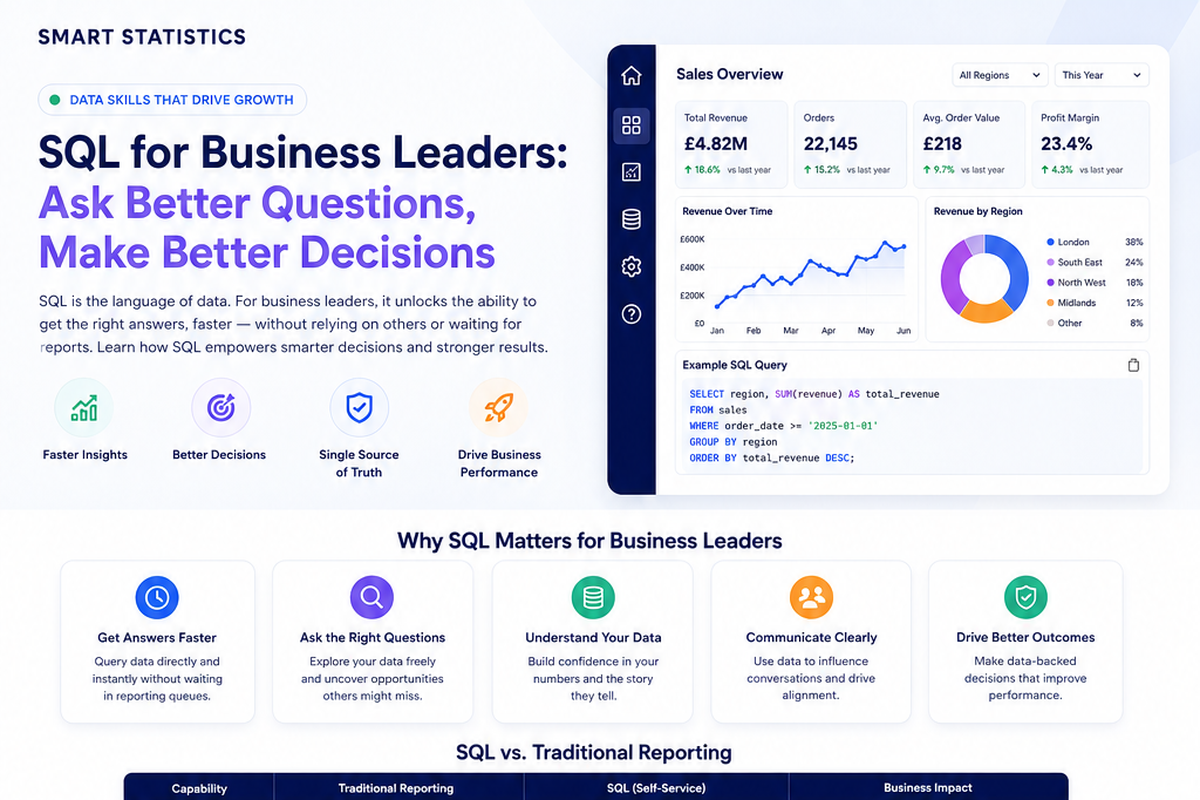
Revenue Over Time
Revenue by Region
SELECT region, SUM(revenue) AS total_revenue
FROM sales
WHERE order_date >= '2026-01-01'
GROUP BY region
ORDER BY total_revenue DESC;Why SQL Matters for Business Leaders
The value of SQL is not limited to IT teams. It gives business leaders a clearer understanding of how data is structured, where metrics come from and how to investigate performance without relying entirely on pre-built reporting.
Get Answers Faster
Query data directly and respond to questions quickly instead of waiting for a new report, export or dashboard change.
Ask Better Questions
Explore detail, compare segments and investigate exceptions that may not be visible in summary reporting.
Understand Your Data
Build confidence in tables, relationships, filters and the logic behind the numbers used in decision-making.
Communicate Clearly
Use specific data questions and evidence to improve conversations with analysts, managers and operational teams.
Drive Better Outcomes
Move from broad assumptions to evidence-based actions that improve performance, service, cost and commercial results.
Move from Static Reports to Flexible Exploration
Traditional reports answer known questions. SQL helps you investigate new questions as they arise, making it particularly valuable when performance changes unexpectedly or leaders need more detail.
| Capability | Traditional Reporting | SQL-Based Exploration | Business Impact |
|---|---|---|---|
| Speed | Days or weeks for a new report request | Minutes for a focused query | Faster decisions and response |
| Flexibility | Limited to pre-built measures and pages | Explore different filters, groups and calculations | Answers new questions quickly |
| Ownership | Dependent on analysts or reporting teams | Greater self-service for capable users | Reduced reporting backlog |
| Insight Depth | Headline summaries and fixed drill paths | Granular records and detailed segmentation | Better root-cause understanding |
| Repeatability | Manual exports and spreadsheet manipulation | Saved, reusable and auditable queries | More consistent analysis |
A Practical Route from Foundations to Business Action
Business leaders do not need every advanced SQL feature. The greatest value comes from learning a focused set of concepts that support everyday analysis and better conversations with data teams.
Understand Data Foundations
Learn how tables, fields, keys and relationships organise business data.
Write Simple Queries
Use SELECT, FROM, WHERE and ORDER BY to retrieve relevant records.
Filter and Aggregate
Summarise performance using GROUP BY, COUNT, SUM and averages.
Join and Combine Data
Bring customer, sales, finance and operational data together responsibly.
Turn Insight into Action
Build reusable analysis that supports decisions and measurable improvement.
What SQL Capability Can Change in Your Organisation
The exact results depend on your starting point, but stronger SQL capability can reduce delays, improve confidence and help teams make more informed decisions with the data already available.
Faster Time to Insight
Reduce the delay between a question and a usable answer.
Less Reporting Backlog
Enable capable users to answer focused questions independently.
Lower Reporting Cost
Reduce repetitive custom report development and manual rework.
Better Decision Outcomes
Improve accuracy, speed and confidence in operational decisions.
SQL for Business Leaders: Questions Answered
Do business leaders need technical experience to learn SQL?
Can SQL connect to our existing business data?
How long does it take to learn useful SQL?
Is SQL training only suitable for analysts and IT teams?
Does SQL replace Power BI?
How can Smart Statistics help?
Unlock the Power of SQL in Your Business
Empower your teams to ask better questions, uncover deeper insight and make decisions based on trusted evidence rather than static summaries.
Smart Statistics can help you connect SQL capability with Power BI, reporting improvement and a wider data strategy focused on measurable business outcomes.