
Smart Statistics · Automation strategy
Automation ROI: Why Hours Saved Are Not Cash Saved
A flow can remove work without reducing a single invoice or salary payment. Build the business case around what the organisation can actually do with the time released.
By Smart Statistics ·
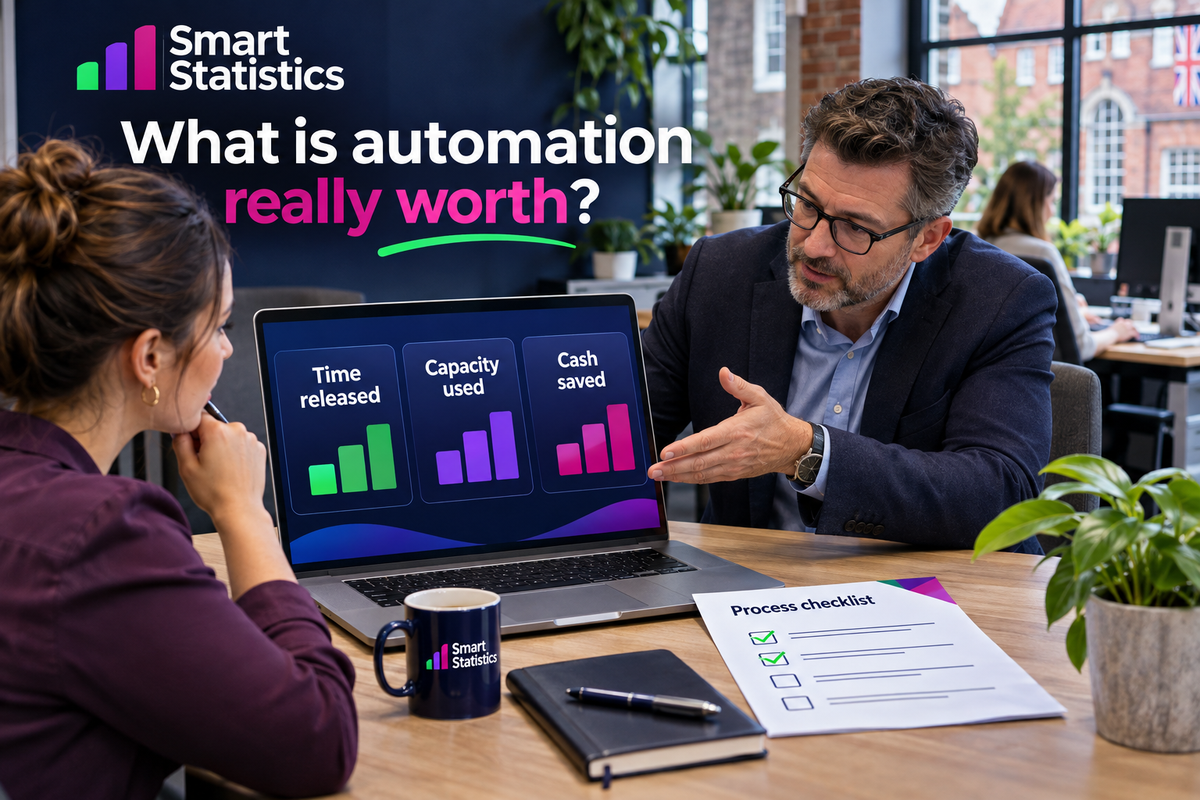
Three benefits. Three different claims.
Illustrative example · fictional monthly business caseFrom potential to practical capacity
Illustrative example · all chart figuresEvidence behind the numbers
Demand: count unique business cases
Effort: observe human handling time
Use: identify work that receives capacity
Cash: confirm an actual spending change
The attractive claim that needs another question
A UK service business wants to automate copying standard customer requests from a Microsoft 365 intake process into a work queue. The proposal says each request takes five minutes and there are many requests every month. Multiplying those numbers by an hourly staff cost produces an impressive headline.
But the team still needs to check incomplete requests, handle unusual cases and support the automation. Small fragments of time may arrive across several people, with no change to the rota or workload. The headline becomes credible only when someone explains what changes operationally.
Ask: which work will stop, which work will remain, and what will we do differently with the released capacity? That question belongs in the proposal before the flow is built.
Keep three benefit accounts separate
Time released
Human effort removed after new checks, exceptions and support are deducted. Measure active handling time; waiting for a response is a different measure.
Capacity put to use
Released time that a manager can assign to valuable work. Record the work, owner and expected output. An hourly cost proxy is a valuation assumption, not revenue.
Cash saved
Spending that actually falls, such as an evidenced reduction in paid overtime or a cancelled external service. The same hours must not also be claimed as a separate capacity benefit.
A worked case that includes the inconvenient costs
Illustrative example throughout: the business processes 1,200 requests per month. The manual route takes five active minutes per request. The proposed automation covers 75% of requests and leaves one minute of human checking for each covered request. Uncovered requests keep their original handling time.
| Calculation | Result | Interpretation |
|---|---|---|
| 1,200 × 5 ÷ 60 | 100 hours | Original handling effort. |
| 1,200 × 75% × (5 − 1) ÷ 60 | 60 hours | Gross effort removed from covered cases. |
| 60 − 10 − 6 | 44 hours | Subtract additional exception work and internal support. |
| 44 × 50% | 22 hours | Capacity the manager expects to reassign. |
| 22 × £30 | £660 | Monthly capacity value proxy, not cash saved. |
| £660 − £400 | £260 | Capacity-value surplus after external recurring costs. |
The additional ten exception hours are above the checking time already included. The six support hours cover internal maintenance. The illustrative £400 budget covers incremental external recurring costs; it excludes that internal support effort to avoid deducting it twice. None of these amounts is a Microsoft price quotation.
With an illustrative £3,120 implementation cost, £3,120 ÷ £260 gives 12 months to recover the investment on this capacity-value basis. It is not cash payback. With no verified spending reduction and £400 of new monthly spending, this example has no cash payback.
The implementation estimate should include discovery, build, testing, training and transition effort valued consistently. Treat tax, inflation and discounting separately if the organisation’s appraisal policy requires them; this is a simple operational comparison.
The lower-volume month changes the decision
The base case is not a forecast. Test a quieter month before committing. In this illustrative sensitivity test, coverage, checking time, reassignment rate and hourly value stay fixed. Exception effort scales with volume; internal support remains six hours and external costs remain £400 per month.
| Monthly requests | Net hours released | Capacity value | After external costs |
|---|---|---|---|
| 600 | 19 | £285 | −£115 |
| 1,200 | 44 | £660 | £260 |
| 1,800 | 69 | £1,035 | £635 |
A lower volume may still justify automation for service quality, but the capacity argument has weakened. Also test lower adoption, more exceptions and extra support. Do not assume capacity can be reassigned just because demand is high; check the team’s skills, working hours and competing tasks.
Collect evidence before choosing the design
Observe the current work. Sample ordinary and difficult requests across a representative operating cycle. Record active minutes, rework, handovers and demand. Separate queues and elapsed waiting time from staff effort.
Compare an alternative. A better intake form or removal of an unnecessary handover may deliver much of the benefit without a new flow. Use the best credible alternative as the comparison, not a deliberately inefficient baseline.
Pilot a defined slice. Select a stable request type, preserve a manual fallback and reconcile each business case to its outcome. Count unique requests rather than flow runs, since retries and multiple flows can serve the same case. Record exception handling rather than hiding it in another team’s workload.
Assign the released time. Agree who will use it and for what: clearing an existing queue, handling extra demand or reducing approved overtime. Test whether time arrives in usable blocks. A plan to redeploy capacity is stronger than an unowned percentage.
Cost the Power Automate design you will actually run
Microsoft documents both user and capacity licensing for Power Automate, while Microsoft 365 plans include a limited set of capabilities. Under user licensing, automated and scheduled flows use the owner’s licence context; instant flows use the invoking user’s context. Do not cost a production design from a trial or one developer’s access.
Have the platform owner verify the trigger type, connectors, users, environments, request volume and any desktop automation against current licensing guidance. Obtain a dated commercial estimate for the proposed design. Keep this separate from internal support hours, monitoring, training and future changes.
Show incremental costs for the decision and disclose any allocation of existing shared licences. A licence already paid for is not automatically a new cost, but it still has entitlement and capacity constraints. Record the assumptions so a later design change triggers a new review.
Do not let the benefit disappear between teams
Business owner
Owns the operational target and reallocates the capacity. Confirms whether the intended work was actually completed.
Finance partner
Agrees valuation rules and checks cash claims against spending evidence. Prevents overlapping benefits from being added twice.
Platform owner
Owns technical support, costs and the fallback route. Records recurring effort and material changes to the design.
Team supervisor
Checks adoption and exceptions with users. Spots work that has moved into personal spreadsheets, email or another department.
Review after a normal operating cycle and a peak period. Compare actual demand, coverage, handling time, exception effort and reassigned output with the approved case. Keep benefit evidence proportionate and minimise personal data in monitoring records.
How strong is your automation business case?
This assessment scores the evidence behind a proposal. It does not calculate ROI or approve investment.
Approve a benefit, not just a build
Proceed when the case survives realistic assumptions, the operational outcome matters and an owner can realise the benefit. Record the expected result and what would cause the decision to change.
Redesign when the benefit is credible but excessive exceptions or support consume it. Simplify inputs and process rules before adding more automation.
Defer or stop when demand is too low, ownership is absent or the only positive result depends on valuing every saved minute as cash. A small, well-evidenced improvement can be a better investment than a large flow with an impressive headline.
Common questions
Are hours saved the same as cash savings?
No. Hours released become cash savings only when they lead to a verified reduction in spending. Otherwise they may create useful capacity or improve service.
Can we value capacity using an hourly staff cost?
Yes, as a clearly labelled planning proxy with agreed assumptions. It does not establish extra revenue, cash savings or that every released hour can be used.
Should failed and exceptional cases be included?
Yes. Include the additional human handling, recovery and support work caused by the proposed process. Avoid counting effort already included elsewhere a second time.
Is the worked example a Microsoft pricing estimate?
No. Every figure in the worked example is illustrative. Obtain a current estimate for the actual licensing, hosting and support design before approving a project.
Build an automation case you can defend.
Smart Statistics helps UK businesses assess processes, test automation opportunities and measure the results. Start with a clear baseline and leave with an improvement plan the business can own.