
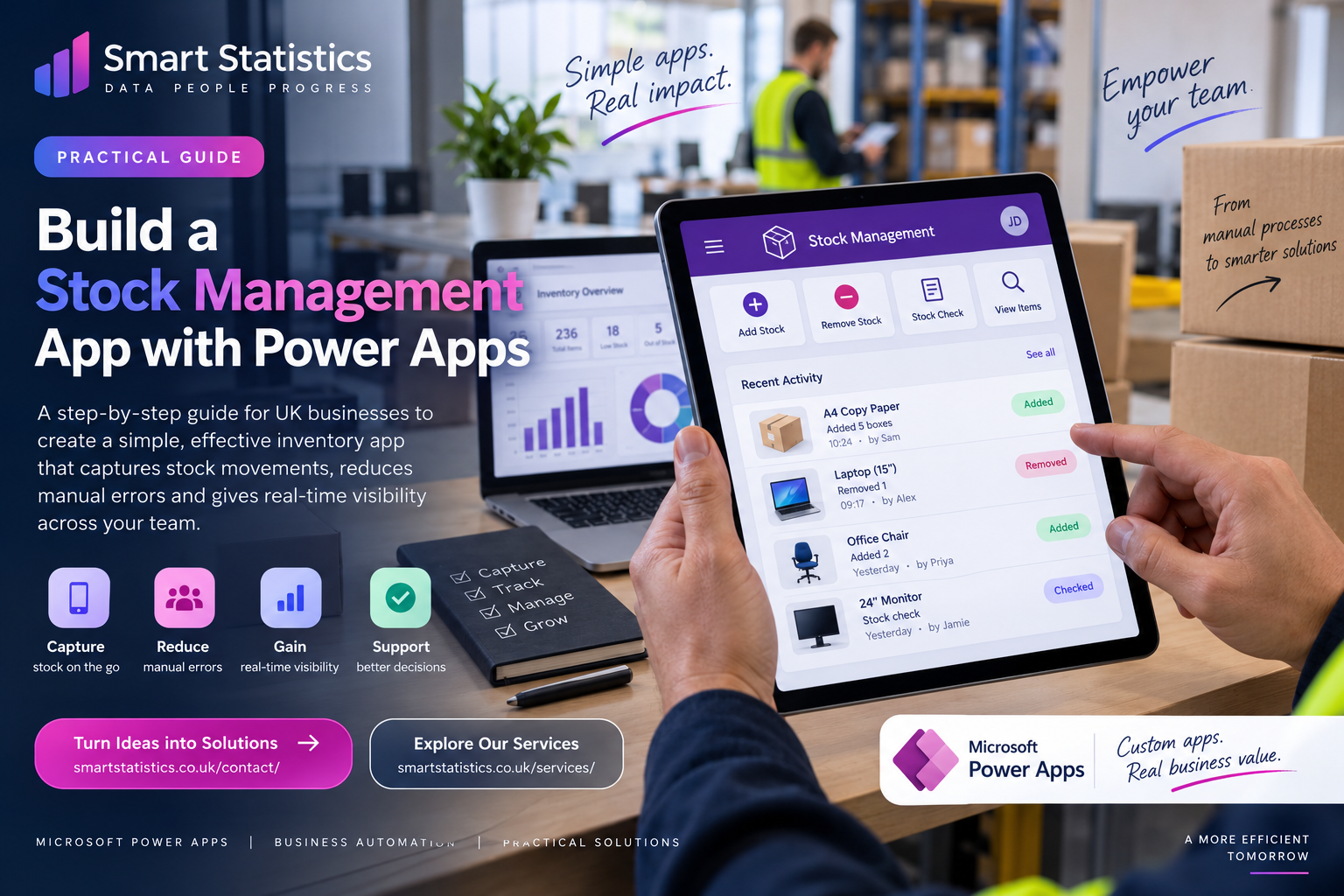
Build a Stock Replenishment App Before the Shelf Runs Empty
Many stock shortages do not begin with a supplier problem. They begin with a visibility problem.
Goods are issued but not recorded. Someone notices that a bin looks low but does not know who should act. Reorder levels live in a spreadsheet that is only checked once a week.
A simple Power Apps solution can capture stock movements at the point of use, calculate whether an item has crossed its reorder threshold and trigger the next action before the shortage disrupts operations.
Items Requiring Attention
Stock vs Reorder Level
Safety Gloves are below the illustrative safety-stock threshold. Create a replenishment task and notify the stock owner.
Stockouts Often Start Before Anyone Notices Them
The issue is rarely just that inventory is low. The bigger problem is that the business discovers it too late.
Spreadsheet Delays
Stock sheets may only be updated at the end of a shift or after someone remembers to enter the movement.
Unrecorded Issues
Materials leave the shelf, but the transaction is not captured consistently enough to maintain accurate visibility.
Late Reordering
Replenishment begins only when somebody spots the shortage, rather than when the threshold is first crossed.
Poor Prioritisation
Teams know several items are low but cannot quickly see which shortage represents the greatest operational risk.
Turn Every Stock Movement into an Actionable Signal
A practical design separates the mobile app, inventory data, business rules and automated actions.
Power Apps
Capture receives, issues, adjustments and stock checks.
Inventory Store
Hold item, location, quantity and threshold data.
Business Rules
Compare available stock with reorder and safety levels.
Power Automate
Notify owners and create replenishment actions.
Management View
Surface critical stock, recent movements and open actions.
Build the App From the Data Up
Create the Inventory Data Model
Start with the information the app needs to make a replenishment decision.
A basic item table could contain:
- Item ID
- Item description
- Location
- Current quantity
- Reorder point
- Safety stock
- Preferred supplier
- Lead time
- Stock owner
Keep stock transactions separately:
TransactionID
ItemID
TransactionType
Quantity
TransactionDate
Location
User
Reference
Build a Simple Stock Movement Screen
Give users the minimum information required to record a movement correctly.
Typical controls:
- Item selector
- Transaction type
- Quantity
- Location
- Reference or reason
- Submit button
For transaction type, you might use:
["Receive", "Issue", "Adjustment"]
A simple Patch pattern:
Patch(
    StockTransactions,
    Defaults(StockTransactions),
    {
        ItemID: ddItem.Selected.ItemID,
        TransactionType: ddType.Selected.Value,
        Quantity: Value(txtQuantity.Text),
        TransactionDate: Now(),
        Location: ddLocation.Selected.Value,
        Reference: txtReference.Text
    }
)
Calculate the Available Quantity
You can maintain a balance directly or calculate it from transaction history depending on the scale and architecture of the solution.
A conceptual transaction calculation is:
Current Stock =
Opening Balance
+ Receipts
- Issues
+/- Adjustments
In a simple Power Apps implementation, you might display current stock using an aggregate over the selected item's transactions.
Turn the Reorder Point into a Visible Status
Do not ask users to mentally compare current quantity with a threshold.
Create a status automatically:
If(
    ThisItem.CurrentQuantity <= ThisItem.SafetyStock,
    "Critical",

    ThisItem.CurrentQuantity <= ThisItem.ReorderPoint,
    "Reorder",

    "Healthy"
)
Use the status to drive:
- Card colours
- Gallery filtering
- Sort order
- Notifications
- Management reporting
Trigger Replenishment with Power Automate
Once the item reaches its agreed threshold, automate the next step instead of relying on somebody to notice.
A flow can:
- Notify the stock owner
- Create a replenishment task
- Send an approval request
- Post an alert to Teams
- Record the action in a replenishment log
Conceptually:
If CurrentQuantity <= ReorderPoint

    → Check whether an open replenishment already exists

    → If not, create replenishment action

    → Notify owner

    → Record alert timestamp
Give Managers an Exception Dashboard
The management screen should help somebody decide what needs attention today.
Useful KPIs include:
- Items below reorder point
- Items below safety stock
- Open replenishment actions
- Recent stock adjustments
- Items with repeated shortages
- Stock value by location
A detailed action table can show:
- Item
- Location
- Current quantity
- Reorder point
- Lead time
- Supplier
- Owner
- Action status
When Should the App Trigger Replenishment?
Change the illustrative stock values below to see how the operational status changes.
Inventory Inputs
These figures are illustrative examples only.
Illustrative Action Status
A real implementation should use business-approved reorder and safety-stock policies.
A Good App Does More Than Digitise the Form
The application should improve control over who changes stock, how movements are recorded and who owns replenishment.
Named Ownership
Every critical item or stock group should have a clear person or team responsible for replenishment.
Audit History
Record who changed stock, when it changed and why the transaction occurred.
Controlled Thresholds
Reorder points and safety-stock levels should be maintained deliberately rather than changed ad hoc.
Exception Review
Repeated shortages should become improvement opportunities, not merely repeated emergency purchases.
Power Apps Inventory FAQs
Can Power Apps be used for inventory management?
Should I use SharePoint or Dataverse?
Can Power Automate send low-stock alerts?
How do I prevent repeated low-stock notifications?
Can the app support multiple locations?
Can barcode scanning be added later?
Can Power BI report on the inventory data?
How can Smart Statistics help?
Do Not Wait for an Empty Shelf to Tell You Something Needs Reordering.
Smart Statistics helps UK businesses turn everyday operational processes into practical Power Apps solutions that improve visibility, reduce manual administration and make the next action clearer.
Whether the requirement involves stock, equipment, approvals, site operations or internal workflows, the objective is the same: capture better information at the point of work and turn it into a controlled business process.