
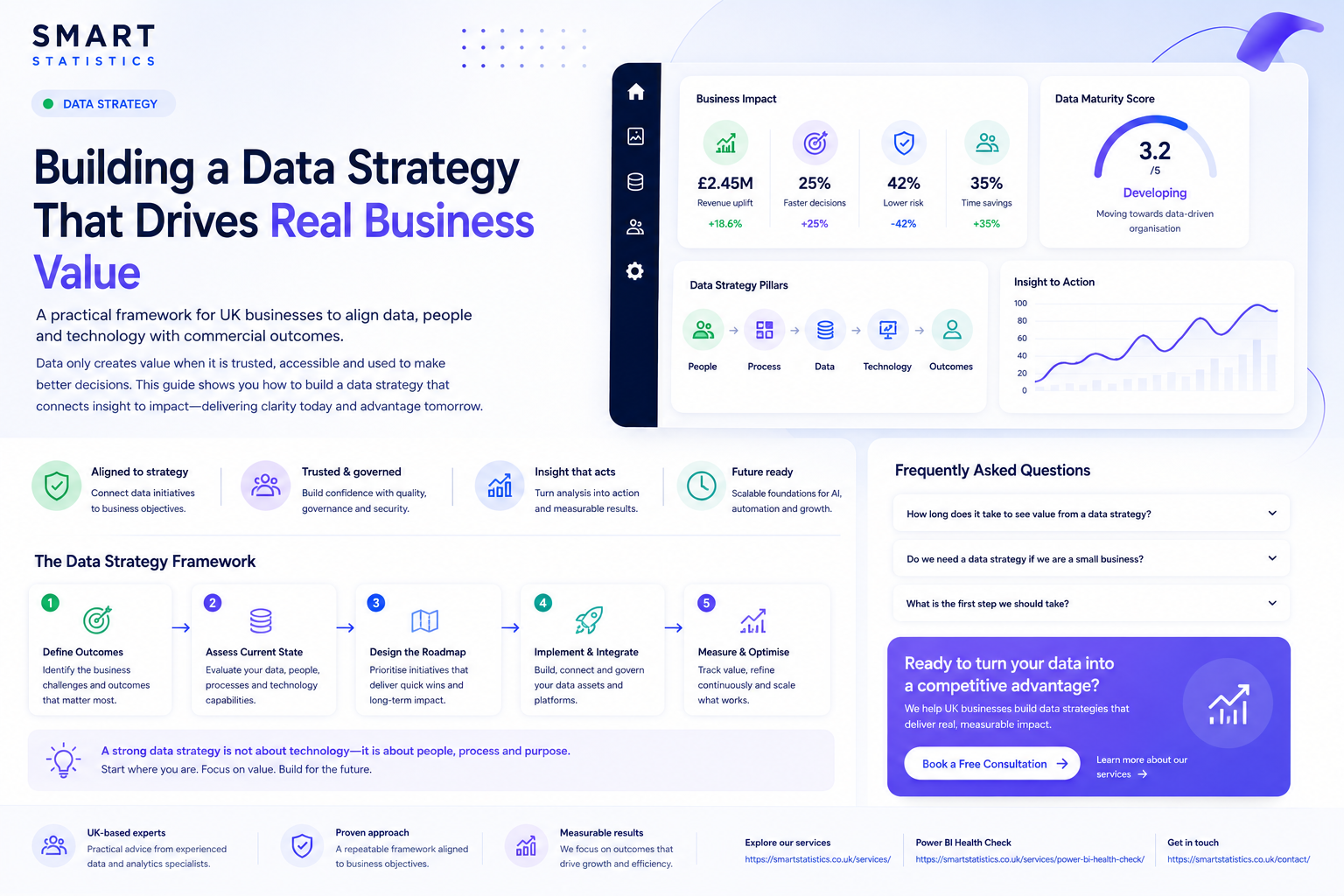
Building a Data Strategy That Drives Real Business Value
Data only creates value when it is trusted, accessible and connected to the decisions that matter. A strong data strategy gives your organisation a practical plan for aligning people, processes and technology with measurable commercial outcomes.
This guide explains how UK businesses can improve reporting, strengthen governance, reduce risk and create a scalable foundation for automation, artificial intelligence and long-term growth.
Business Impact
Data Maturity Score
Data Strategy Pillars
Insight to Action
Data Is Valuable Only When It Supports Better Business Decisions
Many organisations collect large volumes of data but still rely on spreadsheets, manual reconciliation and conflicting reports. The problem is rarely a shortage of data. It is the absence of a shared direction for how data should be governed, managed and used.
Slow Decision-Making
Leaders spend too much time waiting for reports, validating figures or asking teams to explain why different dashboards show different answers.
- Delayed management information
- Manual report preparation
- Limited access to current performance
Conflicting Metrics
Teams define revenue, productivity, service, cost or workforce measures differently, creating avoidable disagreement and reducing trust.
- Multiple versions of the truth
- Unclear KPI ownership
- Inconsistent business definitions
Weak Governance
Data ownership, security, quality standards and access controls are unclear, increasing operational, regulatory and reputational risk.
- Unclear accountability
- Uncontrolled data access
- Limited documentation
Disconnected Investment
New platforms and reporting tools are purchased without a clear roadmap, leading to duplicated capability, fragmented ownership and poor return on investment.
- Overlapping technology
- Unclear priorities
- High support complexity
Low Data Confidence
Users do not fully trust the data, so they export reports into Excel, maintain their own calculations and create parallel reporting processes.
- Manual validation effort
- Local spreadsheet workarounds
- Reduced dashboard adoption
Limited Scalability
Reporting and analysis depend on individual specialists or fragile manual processes that become increasingly difficult to maintain as the organisation grows.
- Single-person dependency
- Repetitive administration
- Slow delivery of new insight
Five Steps to Build a Value-Focused Data Strategy
A useful data strategy does not begin with software selection. It begins with a clear understanding of business priorities, current capability and the decisions that data must support.
Define the Outcomes
Identify the business problems, decisions and measurable outcomes that matter most.
Assess the Current State
Review data, people, processes, reporting, technology, governance and maturity.
Design the Roadmap
Prioritise initiatives by value, urgency, risk, dependency and delivery effort.
Implement and Integrate
Build trusted models, reporting, governance and data capabilities in manageable phases.
Measure and Optimise
Track value, adoption, quality and delivery, then continuously improve what works.
What a Good Data Strategy Changes in Practice
The strategy should translate into visible improvements in how data is governed, reported and used across the organisation.
| Capability | Common Current State | Target State |
|---|---|---|
| Business Alignment |
Reactive
Initiatives are driven by isolated requests, technology availability or urgent reporting problems. |
Outcome-led
Investment is aligned to strategic priorities, decision needs and measurable outcomes. |
| Data Quality |
Inconsistent
Problems are discovered manually after reports have been distributed. |
Controlled
Quality rules, ownership and monitoring are built into the process. |
| Reporting |
Fragmented
Multiple spreadsheets and dashboards provide conflicting answers. |
Trusted
Shared definitions, governed models and consistent KPIs support decisions. |
| Governance |
Informal
Ownership, access and responsibilities are understood by a small number of individuals. |
Defined
Roles, policies, access controls and accountability are clearly documented. |
| Technology |
Disconnected
Tools are introduced independently, creating duplication and support complexity. |
Integrated
Architecture decisions support scale, reuse and long-term capability. |
The Outcomes a Strong Data Strategy Should Deliver
The purpose of a data strategy is not to create a document. It is to improve the organisation's ability to make decisions, manage risk and deliver value.
Data Strategy Questions Answered
What is a business data strategy?
Does a small or medium-sized business need a data strategy?
How long should a data strategy take to create?
Should the strategy include Microsoft Fabric or Power BI?
How do you measure whether a data strategy is successful?
Build a Data Strategy That Creates Measurable Business Impact
Smart Statistics can help you assess your current data and reporting environment, define clear priorities and create a practical roadmap aligned to your business objectives.
Whether you need better reporting, stronger governance, process automation or a foundation for Microsoft Fabric and AI, the right strategy helps you invest with greater confidence.