
From fragmented data to trusted decisions
Microsoft Fabric can simplify a tangled analytics estate—but only when the platform is built around business decisions, clear ownership and governed delivery. This practical roadmap shows UK organisations where to start, what to sequence and how to avoid an expensive technology-first rollout.
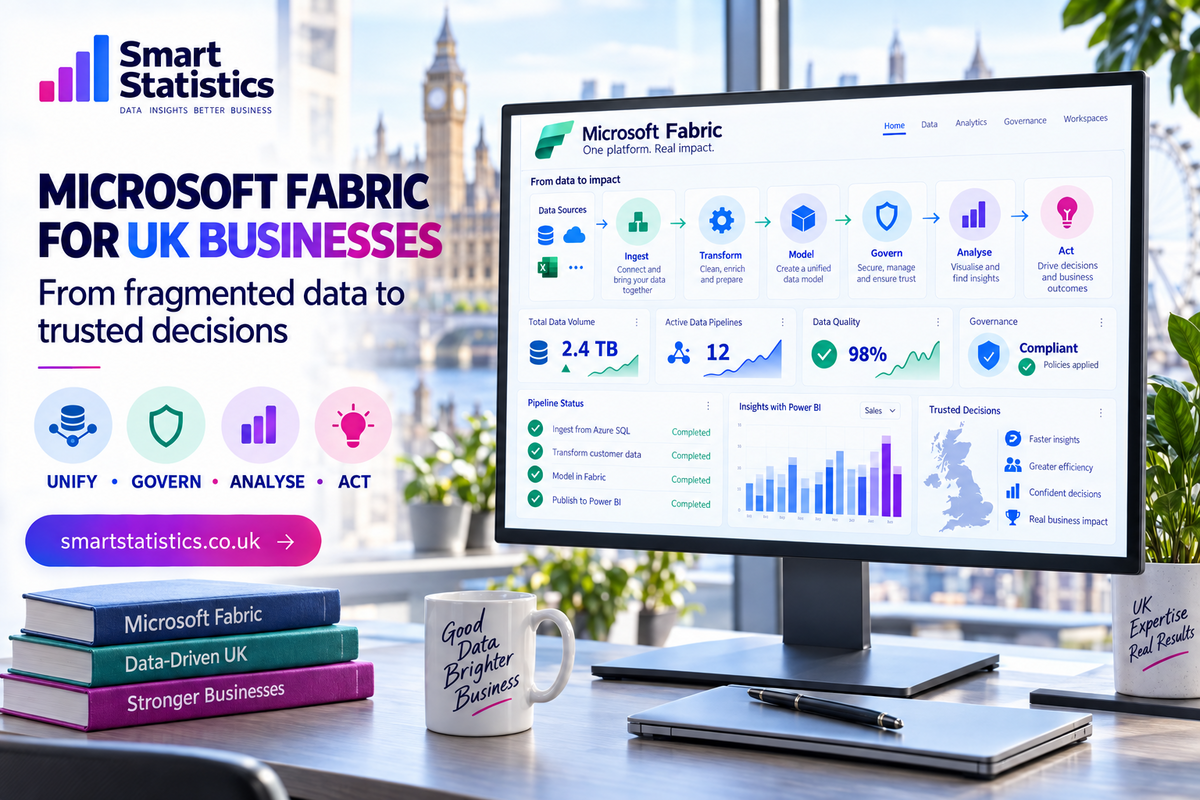
Illustrative example · Demonstration data, not live business results
Fabric is not a migration project. It is a decision system.
A platform can be technically unified while the business remains confused. The hardest work is deciding which data matters, who owns it and how it will change an operational or management decision.
Fragmented ownership
Teams optimise their own extracts and reports, creating overlapping logic and no obvious source of truth.
Slow reporting cycles
Analysts spend the reporting window collecting and reconciling data instead of explaining performance.
Uncontrolled scale
Workspaces, pipelines and capacity costs grow before standards, monitoring and accountability are established.
Sequence the work from outcome to platform
Start narrow enough to learn quickly, but design the pilot so its controls and patterns can be reused.
Choose one valuable decision
Define the decision, audience, cadence and consequence of delay. Avoid beginning with a list of systems to migrate.
Map the minimum data product
Trace the few sources, fields, transformations and definitions required to support that decision reliably.
Design the Fabric landing zone
Agree capacity, workspace boundaries, deployment stages, naming, access groups, gateways and monitoring before building.
Build a thin end-to-end slice
Connect, transform, model and present the smallest useful product. Make the complete delivery path work before adding breadth.
Prove trust and operability
Test quality rules, lineage, refresh recovery, security, usage and handover. A dashboard is not complete until it can be operated.
Scale the reusable pattern
Expand only after outcomes are visible. Reuse standards, automation and governance while allowing domains to retain clear accountability.
A governed path from source to business action
Fabric experiences are capabilities within a delivery system. The business outcome depends on the controls and ownership between them.
Turn a pilot into a repeatable capability
Discover
Frame value, constraints and data ownership.
- Interview decision-makers and operators
- Baseline reporting effort and delay
- Identify security and residency needs
Design
Create the minimum viable architecture and controls.
- Choose lakehouse or warehouse patterns deliberately
- Define environments and deployment
- Set capacity and monitoring thresholds
Deliver
Build the full slice with business users involved.
- Automate ingestion and transformations
- Test shared measures with users
- Design exception-led reporting
Operate and scale
Make improvement, cost and trust visible.
- Review quality, usage and capacity
- Retire duplicate processes
- Prioritise the next data product by value
Three UK business patterns with clear operational value
Finance performance
Combine ledger, budget and operational drivers into controlled management reporting with reconciled definitions and drill-through.
Operational flow
Join orders, inventory and fulfilment events so teams can act on delays and exceptions before customers feel the impact.
Customer service
Connect demand, case handling and service outcomes to expose repeat contact, bottlenecks and preventable failure demand.
Is your organisation ready for a Fabric pilot?
Select every statement that is already true. The score is a conversation starter, not a technical assessment.
Scale with control—without slowing useful work
Workspace design
Organise by product and lifecycle, with clear ownership and promotion paths.
Access and sensitivity
Use groups, least privilege and consistent classification for business data.
Quality and lineage
Make rules, failures and downstream impact visible to owners and users.
Capacity accountability
Monitor usage, peaks and inefficient workloads before cost becomes a surprise.
Questions UK leaders ask before they commit
What is Microsoft Fabric?
Microsoft Fabric is an integrated analytics platform that brings data integration, engineering, science, warehousing, real-time analytics and business intelligence together around OneLake.
Should we migrate everything at once?
Usually not. Start with one bounded, valuable data product. It creates evidence, exposes practical constraints and produces a reusable delivery pattern before wider migration.
Does Fabric replace Power BI?
No. Power BI is a core Fabric experience for semantic modelling, reporting and decision support. Fabric broadens the integrated platform around it.
Do we need a lakehouse or a warehouse?
The choice depends on data shape, team skills, transformation patterns and serving needs. Many organisations use both, guided by consistent governance rather than a one-size-fits-all rule.
How should governance begin?
Begin with ownership, workspace design, access, sensitivity, lineage, quality, monitoring and cost accountability. Apply them to the pilot so governance becomes part of delivery.
Build your Fabric roadmap around real business value
Smart Statistics helps UK businesses turn fragmented reporting into governed, practical analytics solutions across Microsoft Fabric and Power BI.