
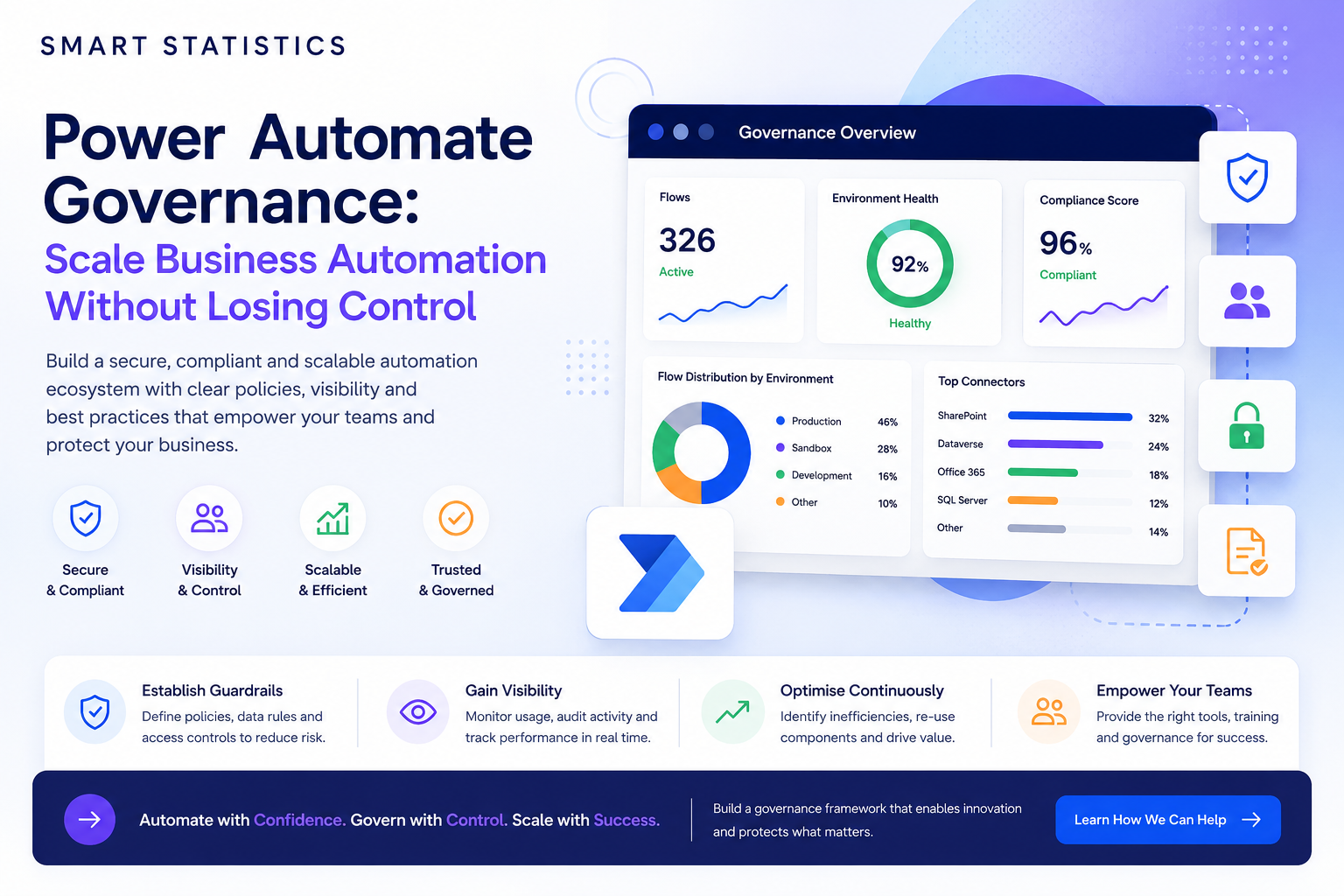
Power Automate Governance: Scale Automation Without Losing Control
Power Automate can remove repetitive work, connect systems and accelerate approvals. But as more teams create flows, organisations can quickly lose visibility of ownership, risk, support and business dependency.
This guide explains how UK organisations can govern Power Automate without blocking innovation—creating a practical operating model that supports secure, reliable and scalable automation.
Governance Maturity Trend
Risk Controls
Automation Becomes Business-Critical Faster Than Many Organisations Expect
A flow that begins as a simple productivity improvement can quickly become part of finance, HR, operations, customer service or compliance.
Unknown Dependency
Flows may support important transactions without being recognised as operational systems.
- Hidden process dependency
- No continuity plan
- Unclear criticality
Unclear Ownership
Automations remain connected to individuals who may change roles or leave.
- Personal credentials
- Orphaned workflows
- Support delays
Data and Security Risk
Connectors and permissions may move sensitive data beyond the intended boundary.
- Inappropriate connectors
- Excessive permissions
- Weak data controls
Uncontrolled Growth
Similar flows are repeatedly created, increasing complexity and support cost.
- Duplicated automation
- Inconsistent patterns
- Rising maintenance
Limited Documentation
Business rules and exception handling remain hidden inside the flow.
- Knowledge concentrated
- Difficult handover
- Slow incident response
No Value Measurement
Organisations count flows but do not measure time, quality or business impact.
- Unclear return
- Poor prioritisation
- Limited optimisation
Five Steps to Build a Scalable Automation Operating Model
Governance should be proportionate. Critical workflows require stronger controls than low-risk personal productivity flows.
Discover and Classify
Inventory flows by impact, sensitivity, ownership and criticality.
Assign Ownership
Define business owners, technical owners and support routes.
Apply Guardrails
Control environments, connectors, sharing and data policies.
Standardise Delivery
Use common naming, testing, documentation and deployment patterns.
Monitor and Improve
Track failures, usage, value, risk and retirement opportunities.
What Effective Governance Changes in Practice
The target is a transparent, supportable automation estate with appropriate standards and clear accountability.
| Capability | Common Current State | Governed Target State |
|---|---|---|
| Ownership | Unclear Flows depend on individual accounts and informal knowledge. | Accountable Business and technical owners are recorded and reviewed. |
| Environment Strategy | Ad hoc Development and production activity are mixed together. | Structured Environment purpose, access and deployment routes are defined. |
| Security | Reactive Connector and data risks are found after deployment. | Preventative Policies and permissions reduce risk by design. |
| Support | Person-dependent Failures rely on the original maker being available. | Resilient Monitoring, documentation and escalation support continuity. |
| Value | Activity-led Success is measured by the number of flows. | Outcome-led Automation is measured through value, adoption and risk. |
Governance Protects the Value of Business Automation
A sound operating model improves the organisation's ability to sustain benefits as automation grows.
Workflow Reliability
Reduce failed runs and preventable incidents.
Operational Risk
Strengthen ownership, permissions and continuity.
Scalable Delivery
Reuse proven patterns and standards.
Return on Investment
Prioritise by value, risk and adoption.
Power Automate Governance Questions Answered
What is Power Automate governance?
Will governance slow down automation?
Who should own a production flow?
Do we need separate environments?
How should organisations monitor flows?
How can Smart Statistics help?
Scale Automation with Confidence
Smart Statistics helps UK organisations turn Power Automate from a collection of individual flows into a reliable, governed and measurable business capability.
The right governance model protects value without restricting innovation.