Reporting & Dashboards
Clarify your reporting requirements, data sources and the most appropriate dashboard approach.

Understand how our consultancy services work, what to expect from an engagement and how business intelligence, automation and advisory support can help your organisation.
Browse answers covering our services, Power BI consulting, systems integration, data security, implementation and ongoing support.
How Smart Statistics works with your organisation.
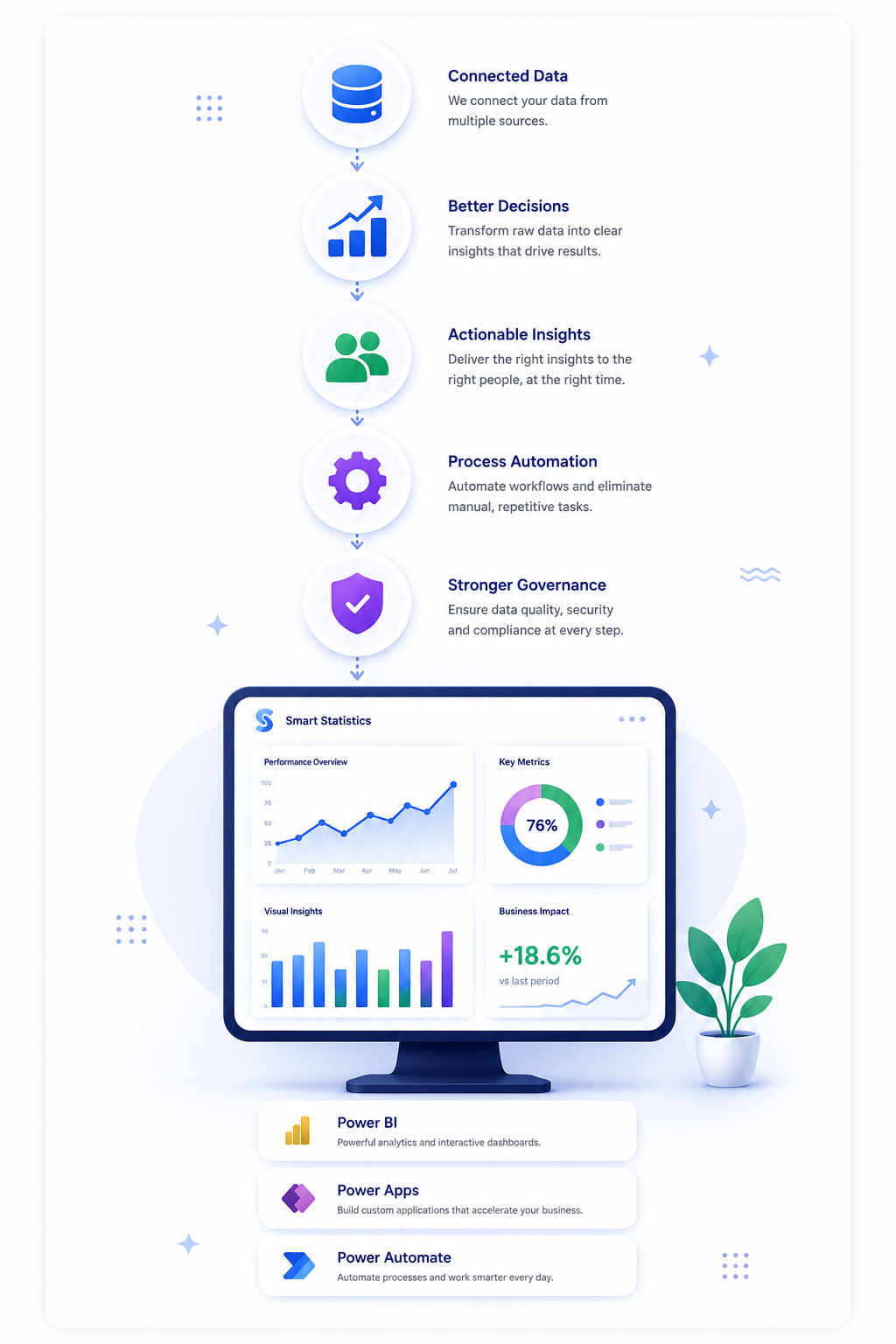
Smart Statistics helps organisations turn fragmented data, manual reporting and inefficient processes into reliable business intelligence, practical automation and clearer decision-making.
Engagements are shaped around the business outcome first. Depending on your needs, that may involve dashboards, reporting automation, process redesign, data strategy, business analysis or ongoing BI support.
We begin by understanding your current applications, data sources, reporting processes and security requirements. Solutions are then designed to work with your existing environment wherever practical, rather than introducing unnecessary replacement technology.
This may include connecting finance systems, CRM platforms, spreadsheets, databases, cloud services, operational applications and other structured data sources.
Yes. We regularly work alongside internal technology, finance, operations and data teams. The engagement can provide specialist expertise, additional delivery capacity, independent assurance or ownership of a defined part of the solution.
Guidance on services, value and implementation.
Power BI consulting provides specialist support for designing, developing, improving and governing business intelligence solutions. A consultant helps translate business questions into trusted data models, dashboards and reporting processes.
The work may include discovery, data integration, KPI definition, dashboard design, performance optimisation, governance, training and ongoing support.
Effective Power BI consulting can reduce manual reporting effort, improve confidence in business information and give decision-makers faster access to relevant performance insight.
Services vary according to the organisation and maturity of its reporting environment. Common areas include:
Power BI can create value in any organisation that depends on data to manage performance or make decisions. This includes finance, healthcare, professional services, manufacturing, retail, human resources, public services and many other sectors.
The strongest results come from designing reporting around the organisation’s decisions and operating model rather than applying a generic dashboard.
Look for a consultant who can demonstrate both technical capability and an understanding of business requirements. They should be able to explain their approach clearly, challenge weak requirements constructively and connect the solution to measurable outcomes.
Relevant experience, evidence of structured delivery, communication quality, governance awareness and post-implementation support are also important.
Data ownership, protection and system connectivity.
Security and data ownership are considered throughout the engagement. Wherever possible, solutions are developed within the organisation’s existing cloud and technology environment so that data, models and access controls remain under its ownership.
The exact approach depends on the solution and will be agreed before access or development begins.
Yes. Power BI can connect to a wide range of data sources, including databases, spreadsheets, cloud applications, CRM systems, ERP platforms and other business applications.
Integration design considers data availability, refresh frequency, security, performance and the quality of the source information.
Power BI includes capabilities for controlling access, managing permissions and restricting which information different users can view. Security can be applied at workspace, report, dataset and row level, depending on the solution.
A secure implementation also depends on appropriate identity management, governance, data-source security, ownership and administration processes.
What influences cost, timescale and preparation.
Cost depends on the scope, complexity and delivery model. Important factors include the number and quality of data sources, reporting requirements, security needs, integration complexity, required dashboards and level of ongoing support.
After an initial discussion, we can define the scope and provide a clear proposal. Productised services, such as the Power BI Health Check, may be available at a fixed price.
A focused dashboard using accessible, well-structured data may produce initial results within a few weeks. Larger solutions involving several systems, complex data modelling, governance and multiple user groups may require a phased implementation over a longer period.
We normally divide delivery into clear stages so that useful outcomes can be released and reviewed before the entire programme is complete.
The level of preparation depends on the maturity, consistency and accessibility of the source data. Information from an established warehouse or controlled operational system may require relatively little preparation.
Spreadsheet-based or manually maintained sources often need more work to resolve inconsistent values, missing information, duplicated records and structural differences.
Data preparation is assessed during discovery so that the required effort and risks are understood before development progresses.
Yes. Support can include issue resolution, report maintenance, dataset changes, performance optimisation, access management, governance reviews and continuous improvement.
Managed BI Support is available for organisations that need an ongoing specialist partner rather than support limited to a single project.
FAQs are useful for general guidance, but the right answer often depends on your data, processes, systems and business priorities. Speak with our team for a clear and practical assessment.
Clarify your reporting requirements, data sources and the most appropriate dashboard approach.
Identify repetitive work, manual hand-offs and practical opportunities to improve process flow.
Establish clearer priorities for data, reporting, governance, ownership and future investment.
Maintain, support and continuously improve an existing reporting environment.
Tell us what you are trying to understand, improve or automate. We will help you identify the most practical route forward.