
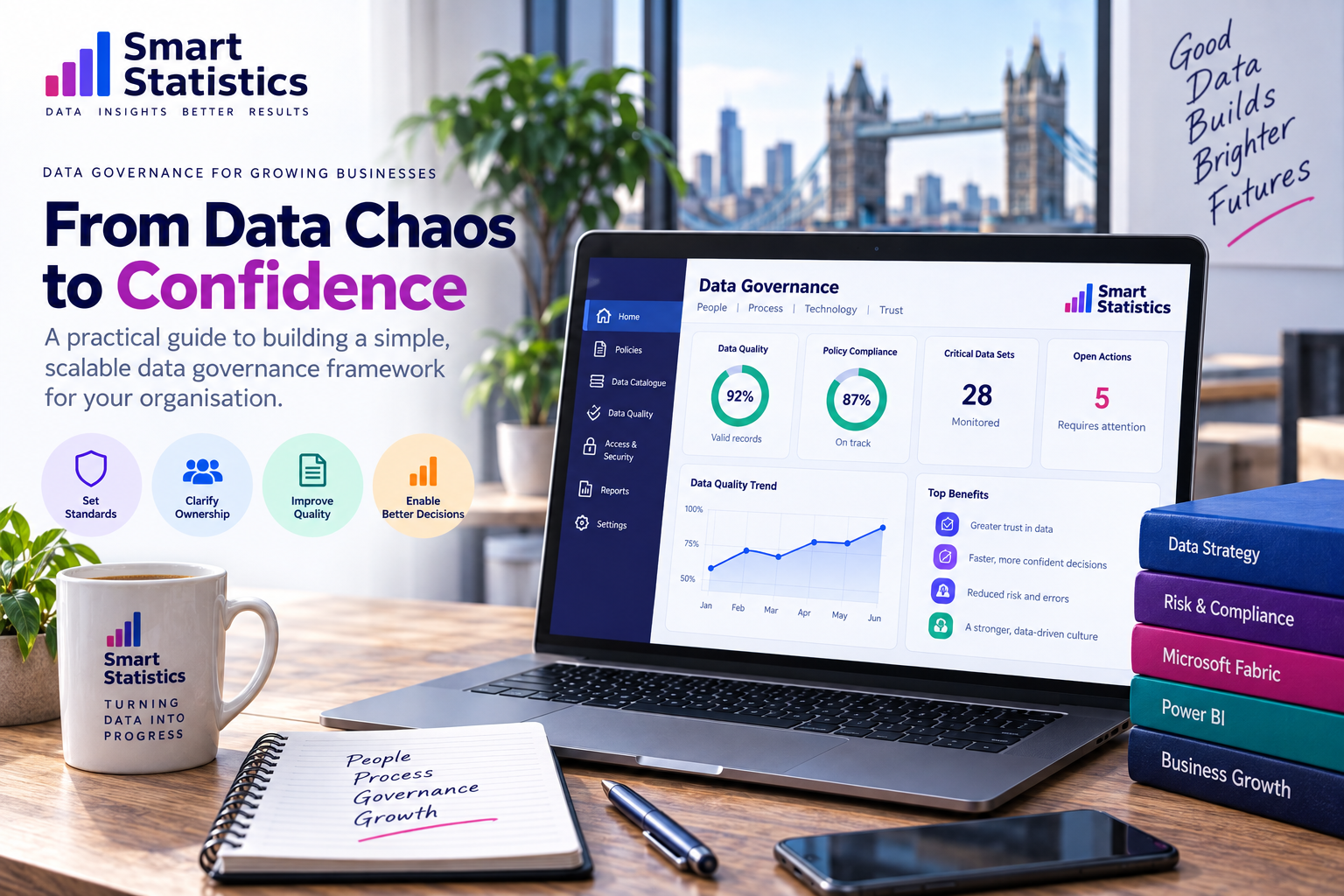
From Data Chaos to Confidence
Growth creates data faster than most businesses create rules for managing it.
New systems appear. Teams create their own spreadsheets. Reports use slightly different definitions. Customer, supplier and operational records begin to disagree. Nobody is completely certain who owns which data issue.
That is where practical data governance becomes valuable. Not as a giant policy programme, but as a simple operating framework that tells people what important data means, who owns it, how good it needs to be and how it should be used.
Data Quality Trend
Governance Outcomes
Focus control on important data and important decisions. Not every field in every system requires the same level of governance.
Data Chaos Rarely Starts with a Major Failure
It usually begins with small inconsistencies that become more expensive as the business grows.
Conflicting Numbers
Finance, operations and sales reports produce different answers to what should be the same business question.
Unclear Ownership
A data issue is discovered but several teams assume somebody else should correct it.
Undefined Data
Familiar terms such as customer, order, revenue or active employee mean different things in different systems.
Access Creep
People gain access to files, reports and systems over time without a clear process for reviewing whether that access is still appropriate.
Govern Data Through Five Simple Questions
A useful framework does not begin with hundreds of policies. It begins with a small number of questions the business can answer consistently.
Ownership
Who is accountable for the business meaning and quality?
Definition
What does this data mean and how should it be interpreted?
Quality
How complete, valid, timely and accurate must it be?
Access
Who should be allowed to view, change or distribute it?
Lifecycle
How should the data be created, retained, reviewed and retired?
Build Governance in the Order Your Business Can Actually Use
Start with the Decisions That Matter
Avoid trying to govern every piece of information at once. Start with the data behind important operational, financial or strategic decisions.
Ask:
- Which reports are relied upon by senior management?
- Which data supports customer or regulatory commitments?
- Which numbers drive pricing, staffing or investment decisions?
- Which data problems repeatedly create rework?
Assign Business Data Owners
Ownership should sit close to the part of the business that understands the data's meaning and consequences.
A data owner might be accountable for:
- Business definitions
- Quality expectations
- Access decisions
- Issue prioritisation
- Approval of significant changes
Define Critical Business Terms
Start a lightweight business glossary for terms that regularly appear in reports and operational systems.
For each term, capture:
- Business name
- Plain-English definition
- Owner
- Source system
- Calculation rule where relevant
- Known exclusions
Turn Data Quality into Measurable Rules
“Improve data quality” is too vague to manage. Define specific tests.
Examples:
- Customer ID must not be blank
- Invoice date cannot be in the future
- Postcode must match an agreed format
- Every active product must have a category
- Supplier payment terms must be populated
An illustrative quality metric might be:
Keep Policies Short Enough to Be Used
A twenty-page governance policy nobody reads has limited operational value.
Separate enterprise policy from practical working standards. Teams should be able to answer:
- What data may I use?
- Where should it be stored?
- Who approves access?
- How should sensitive information be handled?
- What happens when quality is poor?
- Who do I contact when the definition is unclear?
How Mature Is Your Current Data Governance?
Select the controls that are already operating consistently. This is an illustrative diagnostic rather than a formal audit.
Existing Controls
Tick each statement that applies consistently to the business data your organisation relies on most.
Illustrative Governance Score
Your score is based only on the controls selected on this page.
Select the controls that are already operating consistently.
Good Governance Should Increase Confidence, Not Bureaucracy
The framework is working when people spend less time arguing about the data and more time using it.
Greater Trust
Managers understand where important numbers came from, what they mean and who owns them.
Better Decisions
Less meeting time is consumed reconciling competing definitions and conflicting reports.
Reduced Risk
Sensitive and business-critical data has clearer ownership, access controls and escalation paths.
Stronger Data Culture
People recognise that data quality and meaning are business responsibilities rather than somebody else's technical problem.
Data Governance FAQs
What is data governance?
Does a small or growing business need data governance?
Who should own data governance?
What is a data steward?
Do we need a data catalogue?
How does data governance relate to Power BI?
How does Microsoft Fabric fit into data governance?
How can Smart Statistics help?
You Do Not Need More Data Before You Can Make Better Decisions. You Need More Confidence in the Data You Already Have.
Practical data governance helps growing businesses turn scattered information into something people can understand, trust and use.
Smart Statistics helps UK organisations design pragmatic data governance, reporting and analytics approaches that improve business confidence without creating unnecessary bureaucracy.