
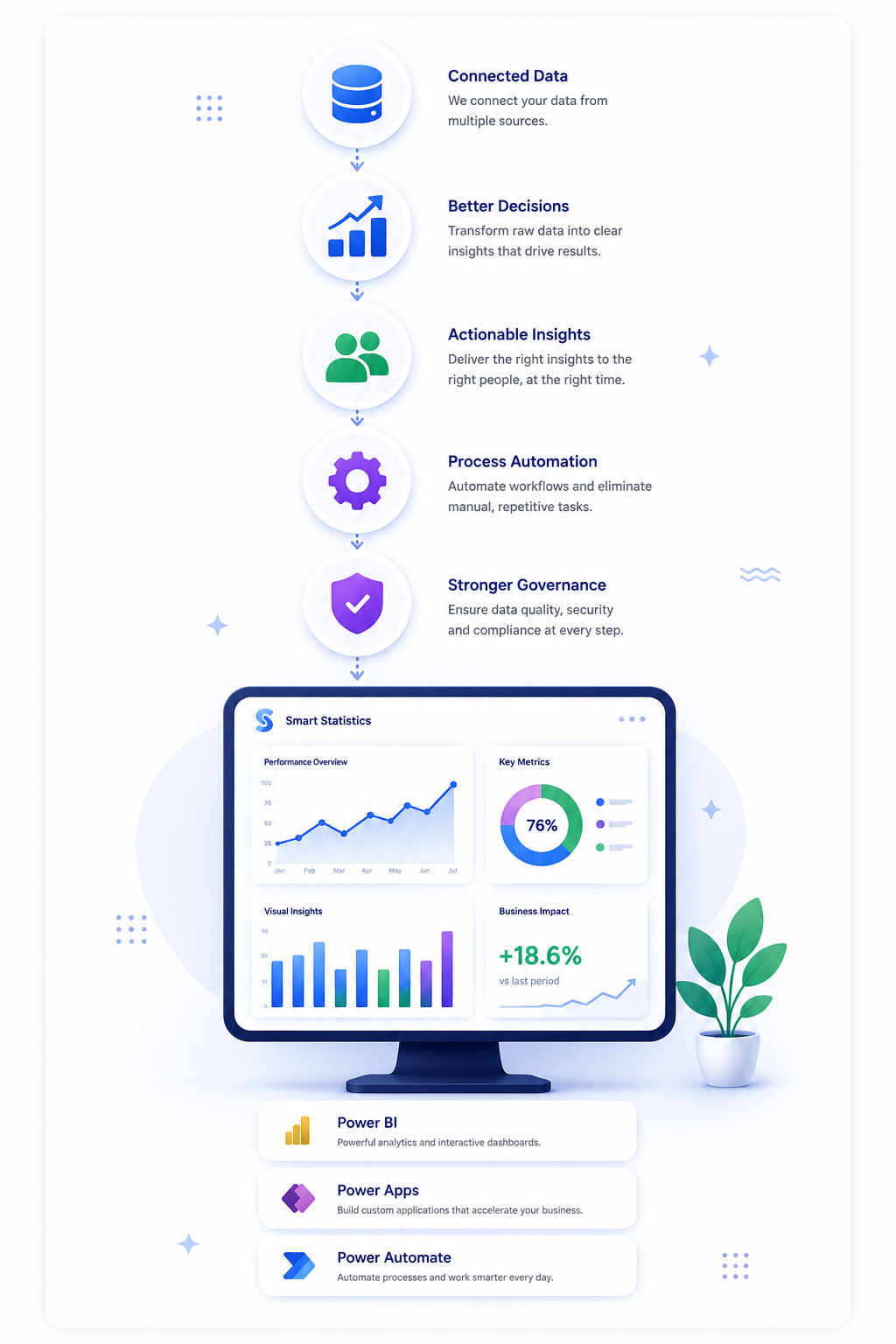

Your Power BI Estate Is Growing Faster Than Your Governance
Power BI adoption often starts successfully. One team builds a useful dashboard, another sees the value, more analysts begin creating reports and the organisation quickly moves from a handful of dashboards to a genuine reporting estate.
The difficulty is that governance rarely grows at the same speed. Before long, businesses can have multiple versions of the same KPI, semantic models with unclear ownership, production reports edited directly, duplicated data preparation and workspaces nobody is quite sure how to manage.
The solution is not to stop self-service reporting. It is to introduce a lightweight operating model that separates trusted production reporting from experimentation while making ownership, reuse, release and support explicit.
How Power BI Technical Debt Starts to Appear
Technical debt rarely arrives as one dramatic failure. It accumulates gradually as small shortcuts become the normal way of working.
Nobody is sure which report is official
Similar dashboards exist in several workspaces with slightly different totals, filters or definitions.
The same KPI is rebuilt repeatedly
Revenue, margin, headcount or productivity logic is recreated inside multiple semantic models rather than reused from a trusted definition.
Production reports are edited directly
Changes move from an analyst's desktop straight into live reporting without a controlled test and release process.
Governance Is More Than Permissions
A practical reporting operating model needs to address ownership, reusable data logic, lifecycle control and support.
Ownership
Every important production report, semantic model and business definition should have accountable owners.
- Business owner
- Technical owner
- Support contact
- Review date
Trusted Data Logic
Shared metrics and semantic models should be reused where that improves consistency and maintainability.
- Common dimensions
- Reusable measures
- Clear definitions
- Trusted sources
Lifecycle
Production reporting should change through an agreed release process rather than informal overwriting.
- Development
- Testing
- Production
- Rollback
Support
Users need to know what happens when a report fails, access changes or a metric looks wrong.
- Refresh failures
- Data quality issues
- Access requests
- Enhancements
Build the Reporting Operating Model in Practical Stages
Governance does not need to begin with a large policy document. Start with the controls that make day-to-day reporting easier to understand and support.
Inventory the reporting estate
Before deciding what to govern, establish what actually exists.
Record:
- Workspace name
- Business area
- Key reports
- Semantic models
- Data sources
- Refresh frequency
- Current owner
- Business criticality
Give production content named ownership
Ownership should not mean one person is expected to fix every technical problem.
Separate responsibilities:
- Business owner: responsible for the reporting purpose and business definitions.
- Technical owner: responsible for the model, refresh, deployment and technical maintenance.
- Data owner: responsible for the upstream source or data domain where appropriate.
Design workspace boundaries deliberately
Workspaces should support an operating model, not simply mirror whichever analyst created the content first.
Useful design questions include:
- Who owns this reporting domain?
- Who is allowed to publish?
- Who can edit production content?
- Is the content departmental or enterprise-wide?
- Does this area need separate development and production environments?
Avoid both extremes:
- One enormous workspace containing everything.
- Hundreds of tiny workspaces with no consistent structure.
Define authoritative semantic models
One of the largest sources of Power BI technical debt is rebuilding the same data logic in multiple models.
Identify models that should become reusable, authoritative sources for common reporting.
Typical examples include:
- Finance
- Sales
- People
- Operations
- Customer
For each trusted model document:
- Business grain
- Core dimensions
- Metric definitions
- Refresh timing
- Owner
- Known limitations
Introduce a release process
A production dashboard should not be the testing environment.
A simple lifecycle might be:
- Development → build and test changes.
- Review → validate measures, visuals, security and refresh.
- Production → release approved changes.
- Monitor → confirm refresh and user experience.
For larger estates, separate development, test and production workspaces may be appropriate.
Define the support model
Governance becomes real when something goes wrong.
Define who responds to:
- Refresh failures
- Gateway problems
- Broken source connections
- Data-quality concerns
- Access requests
- Metric-definition questions
- Enhancement requests
Not every issue needs the same urgency.
Consider simple priority levels:
- P1 → business-critical report unavailable.
- P2 → important data issue with a workaround.
- P3 → enhancement or non-urgent correction.
Review the estate on a recurring basis
Power BI governance is not a one-off clean-up. New models, reports and workspaces continue to appear.
A regular review should look for:
- Orphaned content
- Former employees still listed as owners
- Unused reports
- Duplicate semantic models
- Stale refreshes
- Production assets without documentation
- Unnecessary workspace permissions
Make Responsibilities Explicit
The table below is illustrative. Adapt the role names and responsibilities to your organisation.
| Area | Primary Owner | Typical Responsibility |
|---|---|---|
| Business Definition | Business Owner | Defines what metrics mean and confirms the report answers the intended business question. |
| Semantic Model | BI / Technical Owner | Maintains relationships, DAX, model design, refresh configuration and technical quality. |
| Source Data | Data Owner | Maintains source quality, definitions and upstream operational processes. |
| Production Release | BI Lead / Release Owner | Reviews approved changes and controls promotion into production. |
| Access | Workspace / Platform Owner | Manages roles, security groups and appropriate content access. |
| User Support | Reporting Support Owner | Coordinates incidents, questions and enhancement requests. |
The Best Governance Is Easy to Follow
If governance makes normal reporting unnecessarily difficult, teams will work around it. The operating model should make the safe approach the easiest approach.
Trusted by Default
Users should be able to identify authoritative models and reports without asking around the business.
Standards Before Exceptions
Use repeatable workspace, naming, ownership and release conventions instead of inventing a process for every new dashboard.
Least Necessary Access
Give users the access required for their role without making broad production editing the default.
Measure the Estate
Monitor growth, duplication, ownership gaps and support demand so governance evolves with adoption.
Power BI Governance FAQs
What is Power BI governance?
Does governance stop self-service reporting?
When should a business introduce formal governance?
Should every report have a separate semantic model?
Do we need development and production workspaces?
Who should own Power BI governance?
How often should the estate be reviewed?
How can Smart Statistics help?
Has Your Power BI Estate Outgrown the Way It Is Being Managed?
Smart Statistics helps UK businesses move from fragmented self-service reporting to a practical, governed Power BI operating model without creating unnecessary bureaucracy.
We can help review workspaces, rationalise semantic models, define ownership, improve deployment practices and build a reporting structure that can grow safely with the business.